SelectJet Imagesetter Positive Logo Positivity Tutorials
Exposure and Vacuum
SelectJet Image Setter
 
Positivity home page
SelectJet & CopyJet imagesetter systems
Wasatch SoftRIP software
SelectJet & Copyjet Screen Films
xd imagesetting systems
Imagesetting resources
FAQs on imagesetting systems
Recommendations From Clients
Colour Management
Positivity Contact Details


Losing Detail When Exposing

If you are using an array of black-lights or other diffuse light source you may find that your ability to print fine detail is restricted, here's why:
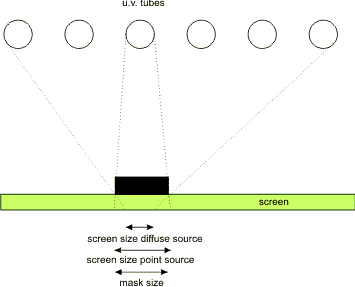
This is a schematic diagram of an exposure unit.

exposure schematic

The mask is in perfect contact with the flat screen. If there was only one small tube the system would approximate to a point source and the light would cure the screen so that the image is faithfully transferred to the screen.

Compare that to the effect of the light from the tubes at the extremes, they are going to undercut the mask and result in a loss of detail and closing of halftones.

If you do not use a vacuum the chances of good contact between mask and screen are nil, and that includes a piece of plywood and some bricks.
Once contact is lost the undercutting is made worse.
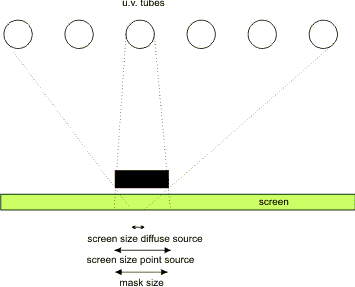
Bad vacuum

  • So point light sources are good, but if you have a point source then most of the energy will be wasted and result in long exposure times. Even commercial exposure units will make a reasonable compromise which leads to the exposure distance being about the same as the diagonal of your screen.
  • Vacuum units are essential for fine detail and halftone printing.
  • The screen in the area between point source and diffuse source will receive a variable amount of light which means that some may wash out other bits won't. You will have variable detail depending on your washout.
  • Over-exposure will make the problems worse because more of the semi-cured emulsion will resist washout.
  • I've shown a flat screen, screens aren't flat, they follow the contours of the mesh. Even with a good vacuum contact will not be perfect.
  • Light travels in straight lines - except when it hits anything, the first thing that happens is light-scattering so that even a perfect system would have some undercutting due to scatter. Tinted mesh absorbs uv light and reduces scatter.
   
Screenprinting Tutorials
from Positivity

Convert a Logo for Screenprinting Corel X4

Simple Exposure Calculation

What is an ICC Profile?

Corel PowerClip

Exposure Problems - details

 
Wasatch Tutorials
and Videos

Spot Colour Replacement

Colour Atlas Generation

Dynamic Layout

Variable Data

RIP Queues

Wasatch ImageNet

Cost Estimation

'Popping' Colour 1

'Popping' Colour 2

Wasatch Port Redirector

Print From a Mac

Hot Folders

Templates


Positivity Contact Details 01793 686 380
Home | Imagesetters | Films | RIP | Clearance | Resources | Feedback | FAQs | Colour | Contact