An ICC profile helps you get the correct colour from a device, but it's a bit of a black box, data goes in and comes out without any hint of the process involved.
Consider how a profile is created.
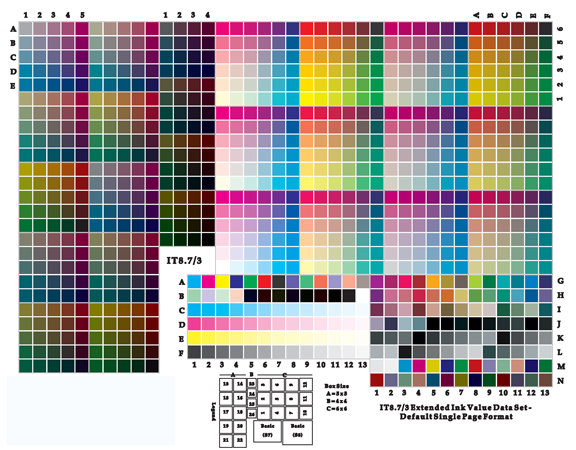
You print out a colour swatch like this one

It is read by a spectrophotometer which records the actual colour that is on the paper.
Colour can be defined in several different systems, printers use CMYK, monitors RGB. These are device dependent colour spaces because they are specific to the system for which they were designed. Lab is a device independent colour space which was developed to act as a standard.
An ICC profile is just a series of CMYK or RGB formulae linked to the colour that results in Lab.
Now when an application 'sees' a colour in a picture it goes to it's ICC profile and converts it to Lab.
From there it has a monitor profile so that it can render the correct colour on screen, it has a printer ICC profile so that it can convert to CMYK and maybe a separations profile so that it can achieve the correct colour on press. Once the Lab colour is known then it is simple to work back to the CMYK or RGB combination that gave that colour.
Note that the first step is to convert to Lab, this is done via the working (or input) profile. This profile is as important as your output profiles and poor choice (by which we mean sRGB) can lead to poor colour. Try AdobeRGB1998 as a good input profile.
Profiling With Wasatch RIP
|